Columns
2025.10.20
Why not pay attention to your child's "pain"?
Children's traumatic experiences behind school refusal
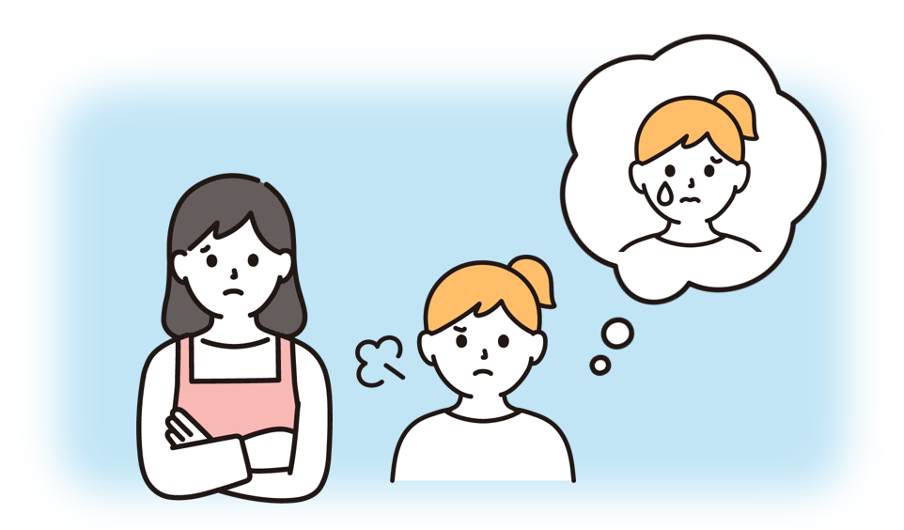
table of contents
School refusal is a child's SOS
"Why can't you go to school?" "Don't be lazy, go to school!"
I can understand how you might feel like saying this to your child who has stopped going to school.
But first, think about it this way.
Your child may be in such a difficult situation that they "cannot go to school even if they want to."
In fact, many studies have already shown that many children who do not attend school suffer from mental and physical problems.
For example, one survey revealed that many children who are not attending school complain of mental disorders such as anxiety and depression, and physical problems such as headaches and stomachaches.
In other words, School refusal is not a problem of a child's laziness or mood, but is likely a sign of a mental or physical SOS.
The "traumatic experience" behind
So why do these "mental and physical SOS" emerge?
Many children who are not attending school complain of problems with interpersonal relationships such as being bullied or not getting along with their teachers, or difficulties with learning such as not being able to keep up with their studies at school.
These psychologically stressful experiences, or "traumatic experiences," may cause physical and mental disorders, resulting in situations where students "cannot go to school even if they want to."What may seem like no big deal to adults can be the most painful experience of a child's life."trauma"This may be the case.
Hurt and trauma cannot be seen from the outside, and it is not uncommon for children to not even be aware of their own hurt or trauma.
Not a problem behavior, but a sign of hurt
In addition to not attending school, hurt children may also exhibit the following behaviors:
- Angry and panicked
- Strong distrust and a testing attitude
- Avoiding, evading, unable to think
- Acting calm and cheerful
- My memory is hazy and vague
When your child displays these kinds of behaviors and actions, you may be tempted to focus on the "behavior" itself, but why not change your perspective a little and consider, "Could this behavior be due to some traumatic experience?"
These may not be "problem behaviors" but "signs of hurt." What is important for hurt children is to "heal their wounds."
Positive experiences help heal
So how do we heal the wounds?
The answer is "positive experiences." It's not something special, and some things can be done at home. For example,Why not take just five minutes a day for parents and children to talk to each other about how they're feeling today?
When doing so, please keep the following in mind:
- Listen to what your child says without rejecting it (accept it without judging it)
- Express your feelings by saying things like "Thank you" or "I was happy"
- Create a safe space (a place where there is no scolding or comparison)
By accumulating these positive experiences,Children's resilience increases dramatically when they feel that "this home is safe" and "their parents care for them."
If you're worried about whether you can do it on your own, it's important to ask for help from people outside the home.
- Be aware of other adults besides family members you can rely on (grandparents, trusted adults in the neighborhood, school teachers, instructors at cram schools or extracurricular activities, etc.)
- Actively participate in local activities (festivals, volunteering, children's groups, etc.)
On this site, you can find information on various public and private support options, so it's a good idea to look together for services that may be suitable for you and your child.
School refusal is not the end
"When can I go back to school?"
"What about studying?"
It's understandable that you might feel this way. However, neither school refusal nor hurt feelings are "the end." The important thing is to believe in your child's abilities and to support them slowly, without rushing.
There are many people who will support you and your child, so let's take things one step at a time together.

NOTES
trauma
Trauma refers to deep emotional scars caused by events that cause intense fear, shock, or anxiety.
It is not only "death-like experiences" that can cause trauma. For example, repeated scolding, being ignored or treated unfairly, or feeling isolated with no way to escape can also be a huge burden on a child's mind and can become traumatic.

The person who edited the article

Director/Chief Researcher
After working as a teacher at a special needs school for over 20 years, she obtained a doctorate in child development, specializing in issues such as child bullying and school refusal.
【references】
■Institute for Child Development Science (2024), Ministry of Education, Culture, Sports, Science and Technology Commissioned Project: Survey Report on Analysis of Factors Affecting School Non-Attendance
https://kohatsu.org/20240325research-report/
■School ACE Research (2023)
https://kohatsu.org/school_ace/
■PCE research: Positive Childhood Experiences and Adult Mental and Relational Health in a Statewide Sample, Associations Across Adverse Childhood Experiences Levels
https://jamanetwork.com/journals/jamapediatrics/fullarticle/2749336